


ROADMAP
PODCAST
earn own
BLOG
LABS
Pre-Sale
Coming Soon

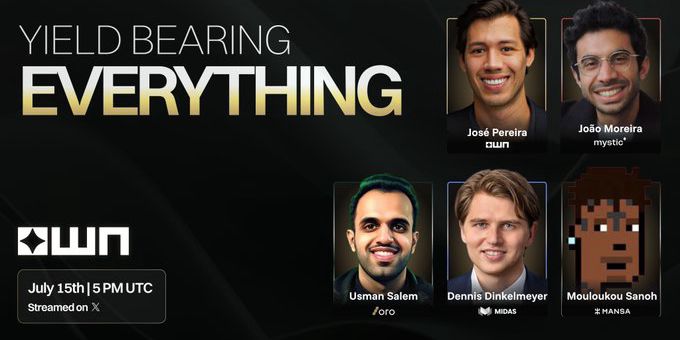
July 15th 2025
“The first thing you do with a yield-bearing asset in crypto is use it in DeFi. That’s what brings the utility.” — João Moreira, Mystic Finance.
As tokenization moves from speculative hype to tangible infrastructure, the real-world asset (RWA) narrative is no longer a “what if,” but a “how far?” A convergence of regulation, yield engineering, and blockchain rails is bringing RWAs into the DeFi spotlight, transforming once-static assets — like gold — into productive, tradable, and composable building blocks of a new financial order.
At the heart of this shift are players like Own Network, ORO Gold, Mansa Finance, and Mystic Finance, who gathered recently to unpack what “yield-bearing everything” truly means in practice — and where it’s all headed.
The tokenized RWA market is growing exponentially. According to rwa.xyz, total value locked (TVL) in tokenized RWAs has crossed $8.1 billion as of July 2025, up from $4.5 billion just six months ago — a near doubling in growth. Tokenized treasuries, gold, and real estate dominate the landscape, but now, esoteric assets like shipping revenues and even carbon credits are entering the fray.
“Everything will be tokenized — but not everything should be,” cautioned Usman Saleem, ORO Gold. “Gold has historically been a non-yielding asset, but through leasing, we’re bringing it on-chain as a productive instrument.”
The roundtable made it clear: the most valuable on-chain RWAs aren’t just digitized — they’re yield-bearing. Usman detailed how traditional bullion leasing markets are being replicated on-chain:
“Jewellers and refiners lease gold from bullion banks. We’re bringing that to the chain — making gold productive and unlocking yield from what used to be a negative-carry asset.”
Mystic’s João Moreira explained how their protocol is optimizing the yield stack:
“You use tokenized gold as collateral to borrow stablecoins, then loop that collateral for leveraged exposure and compounded yield. It’s DeFi 101 for RWAs.”
And Abhinav Mehta, Mansa, is bridging TradFi payments into this ecosystem by financing the backend:
“We’re helping solve the liquidity lag by financing cross-border payments in stablecoins at T+0. For once, idle fiat is generating real yield.”
“Users don’t care if it’s tokenized — they just want yield, liquidity, and security.” — Abhinav Mehta, Mansa.
While the DeFi-native crowd loves looping and leverage, the broader retail market wants simple, frictionless financial products. This is where Fasset and its underlying blockchain, Own Network, come in. As José Pereira put it:
“Our users aren’t buying ‘tokenized gold,’ they’re seeing: ‘Buy gold. Earn 4%.’ The crypto is abstracted away — that’s the killer UX.”
With migrating Fasset’s 400,000+ users and $370M in monthly volume on chain, Own is enabling everyday users — especially in underbanked regions like Pakistan, Indonesia, and parts of Africa — to access products previously unavailable in traditional finance.
“The U.S. doesn’t need tokenized equities. But South America, Africa, and Asia do. That’s where tokenization will have the most impact,” Jose emphasized.
The speakers offered ambitious targets for the year ahead:
Mansa: From $30M to $5B in on-chain payments volume.
Mystic Finance: Aiming for $1B in TVL, supported by innovative junior/senior lending tranches.
ORO Gold: Establishing itself among the top tokenized gold products globally.
Own Network: Becoming the default retail gateway for RWAs, with UX that rivals fintech incumbents.
“The next leap won’t just be in TVL — but in what’s tokenized,” said José “Shipping revenues, sports teams, reinsurance — assets yielding 20–40% annually — are coming on chain.”
But even as tokenized assets proliferate, challenges remain. Chief among them: oracles.
“Crypto price is natively on-chain. RWAs are not. The problem is: how do you trust off-chain data brought on-chain?” said João.
There guys discussed the importance of new approaches to how the industry is to tackle oracle reliability for RWAs. But the consensus was clear: much of the infrastructure still needs to be built out.
Yield is King: Only RWAs that produce yield will see meaningful traction.
Distribution > Everything: UX, licensing, and market access matter more than protocol mechanics.
RWA vs Crypto Native: Bridging risk/reward expectations is critical. Institutions want real yield, not just tokens.
Oracles = Next Frontier: High-fidelity off-chain data input will make or break RWA markets.
Next Phase: The race is on to tokenize high-yield alternative assets: shipping, insurance, credit, carbon, etc.
José Pereira — Own Network https://x.com/jfpereira1 https://x.com/own_xyz
João Moreira — Mystic Finance https://x.com/itsKelmat https://x.com/mystic_finance
Usman Saleem — ORO Gold https://x.com/theusmansal https://x.com/orogoldapp
Abhinav Mehta — Mansa https://x.com/visunkn0wn https://x.com/MANSA_FI
Own Network’s X Spaces Roundtable: https://x.com/i/broadcasts/1ZkKzYeZjDwxv


