


ROADMAP
PODCAST
earn own
BLOG
LABS
Pre-Sale
Coming Soon

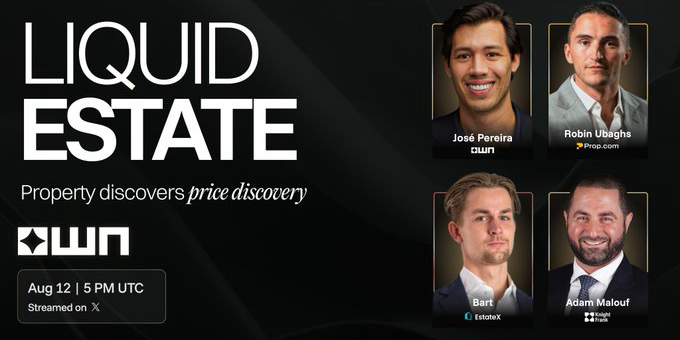
The Own Network X Spaces Roundtable - Liquid Estate - brought together leading voices in tokenized real estate to discuss where the industry is now, where it’s going, and what challenges remain before blockchain truly transforms property markets. Hosted by Gareth Lewis (EVP, Corporate Strategy at Fasset), the conversation featured Robin Ubaghs (CEO, Prop.com), Adam Malouf (Regional Partner & Head of Operations, Knight Frank), and José Fernando Pereira (Co-Founder, Own Network).
Robin Ubaghs argued that most current “tokenized real estate” offerings simply replicate the decades-old crowdfunding model, with blockchain adding little functional improvement - except in rare jurisdictions like Dubai where title deeds can be fractionalized directly.
“Accessibility isn’t new. The real breakthrough will come when we solve the infrastructure problem - getting all property data standardized, real-time, and on-chain.”
According to Robin, the industry overpromises liquidity. Without integrated, trustworthy datasets - transaction records, tenant data, valuations - tokens won’t trade with the speed or confidence true liquidity requires.
Adam Malouf stressed that real estate is the logical asset class for tokenization: it’s tangible, immovable, and easy to title. The UAE, in particular, has succeeded because government, regulators, and market players all pull in the same direction.
“You can’t scale tokenization without top-down support from every stakeholder. That’s why Dubai is ahead of most markets.”
For Adam, scalability is the real prize - moving from one-off villa tokenizations to large, liquid portfolios accessible to retail investors worldwide.
José Pereira highlighted the gap between the UAE and other jurisdictions. In most markets, tokenization happens through Special Purpose Vehicles (SPVs) because local laws restrict fractional ownership. The UAE’s ability to tokenize directly on the title deed is a competitive advantage, but registry modernization is a long road for most countries.
The panel explored whether token holders should have governance rights over the asset, or just economic exposure. Adam noted that retail investors in REITs rarely vote on operational decisions, and large institutional investors will still demand traditional governance structures. Robin added that mass governance on building-level issues is impractical:
“500 people voting on which contractor to change the windows? That’s chaos. Governance should be focused on major economic decisions.”
When asked if asset owners should tokenize now or wait, both Robin and Adam advised caution. The early wave of tokenization attracted mostly low-quality assets looking for “dumb liquidity”- properties struggling to sell through traditional means.
“Good deals always find liquidity. If it’s a quality asset, you don’t need tokenization to sell it.” – Robin
Tokenization can add value for asset owners through operational efficiencies and partial liquidity unlocks, but for most, traditional financing routes are still simpler and cheaper.
Both speakers agreed on the scale of the challenge. Robin estimated it could take five years to reach regional standardization of real estate data, while José suggested it could be 10–20 years for Europe to match Dubai’s title deed capabilities.
Key forecast: Adam and Robin both predict 10% of real estate entitlements will be tokenized within the next decade - but the winners will be those solving the data problem first.
The conversation underscored that tokenization’s true potential lies not in flashy marketing, but in deep infrastructure work - bridging off-chain property realities with on-chain digital asset markets.
For the full conversation see here


